Waterproof 330D Cordura Nylon: PU vs TPU, DWR, IRR, FR & UV Finishes Explained
“Is it waterproof?” is one of the most common questions buyers ask—yet it’s also the most misunderstood.
330D Cordura-type nylon can be engineered from light water resistance all the way to high waterproof performance, depending on the coating/lamination system and finishing package.
In this guide, I’ll break down PU vs TPU, explain what DWR actually does (and doesn’t), and show how to specify IRR/FR/UV finishes for tactical or industrial projects—without overpaying or under-specifying.
For full product specs and our available variants, see:
Nylon 330D Cordura Fabric
1) First, define “waterproof” for your product (not for the fabric)
A fabric’s waterproof rating (hydrostatic head, “mm”) only matters in context.
Ask yourself:
Will this bag face light rain or sustained rain exposure?
Will it be used for commuting or for hiking/trekking?
Is it for an outer shell panel or an inner compartment?
Do you need waterproofing for the fabric only, or also for seams and zippers?
Even a high waterproof fabric will leak if seams aren’t sealed or construction isn’t designed for wet conditions.
2) PU coating on 330D: the practical everyday solution
On our 330D range, PU coating (1–3 layers) is the most common, economical choice.
Typical waterproof level: ~300–2000 mm, depending on structure and layer count.
Best applications for PU-coated 330D
Commuter backpacks
Travel organizers, duffels
Laptop sleeves and daily bags
Pros
Cost-effective
Stable and widely available
Easy to tune for stiffness and body
Cons / watch-outs
PU hydrolysis risk varies by formulation and storage conditions
“PU coated” is not one spec—layer count and resin quality matter
Buyer tip:
Don’t just ask “PU coated.” Ask:
“How many layers?” (1–3)
Target waterproof rating (mm)
Adhesion expectations and aging guidance
Whether you need “soft handfeel” or more structure
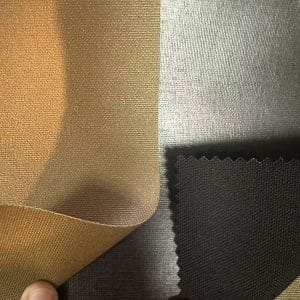
For higher waterproof needs, TPU lamination is the upgrade path.
Typical waterproof level: ~3000–8000+ mm, structure-dependent.
Best applications for TPU laminated 330D
Rain-exposed compartments on outdoor packs
Lightweight performance packs
“Cleaner backing” / premium feel products
TPU laminations often look smoother and can provide a cleaner, more technical aesthetic—especially when paired with a good face fabric and consistent lamination.
Buyer tip:
If you’re developing a “waterproof capsule” (like a top lid, front pocket, or internal dry compartment), TPU lamination is usually the more convincing story than simply adding more PU layers.
4) DWR finishing: what it does (and why you still want it)
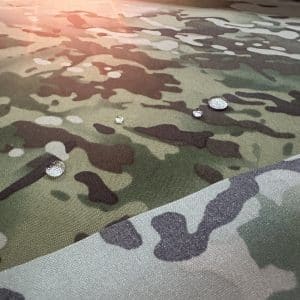
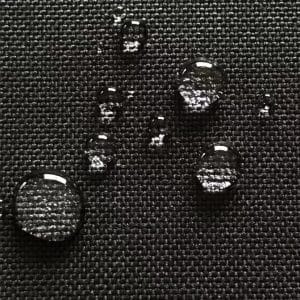
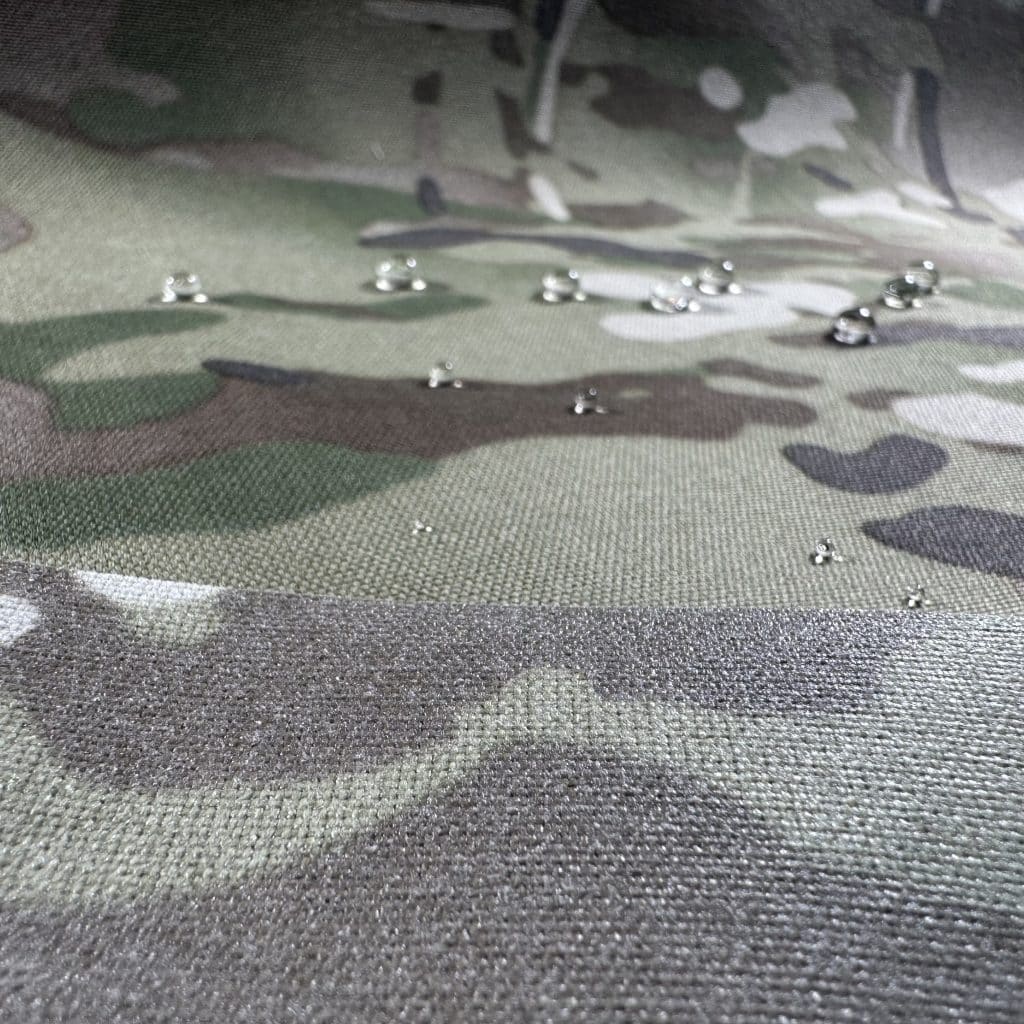
DWR (Durable Water Repellent) improves surface beading and reduces “wet-out” on the face fabric.
What DWR does:
Helps water bead and roll off
Keeps the fabric looking cleaner in light rain
Reduces surface saturation, improving comfort and appearance
What DWR does NOT do:
It does not replace PU/TPU waterproof backing
It does not seal seams or zippers
Best practice:
For outdoor packs, a common combo is:
Face: DWR
Back: PU or TPU, chosen by waterproof requirement
5) IRR finishing: when tactical projects demand signature control
If your buyers are in military or professional law enforcement procurement, you may hear: IRR (Infra-Red Reduction).
Our 330D line supports Multicam-style 330D with IRR finishing on request for tactical applications.
When IRR matters
Professional tactical gear projects
Uniform/gear systems where compliance is required
Certain export or tender requirements
When IRR is unnecessary
Civilian outdoor packs
Lifestyle/urban backpacks
Travel organizers
Buyer tip:
Always confirm:
The required test method/standard (if specified)
Whether the requirement applies to the print, the dye, or the full construction
Batch consistency expectations
6) FR (flame retardant) treatment: niche, but critical in some markets
For industrial or protective applications, FR treatment can be requested for 330D.
FR is relevant for:
Industrial protective gear
Certain workwear accessories
Special protection environments
Buyer tip:
“FR” is never one thing. Clarify:
FR standard required by the market (if applicable)
Whether FR must be durable after washing
Any restricted substances requirements
7) UV resistance, calendaring, printing: performance + aesthetics
Depending on where the bag will be used, UV resistance can help maintain appearance. We also support optional printing and calendaring.
UV-resistant: helpful for prolonged sun exposure
Printed / camouflage: brand styling or tactical pattern programs
Calendared: can improve surface feel/appearance depending on target look
8) A decision matrix: which finish package should you choose?
If you make commuter backpacks (daily rain, city use)
Weave: Plain
Backing: PU coating (1–2 layers)
Face: DWR
Goal: practical water resistance + good handfeel
If you make lightweight outdoor packs (regular rain exposure)
Weave: Plain or ripstop
Backing: TPU lamination
Face: DWR
Goal: higher waterproof + performance feel
If you make tactical accessories (light-duty MOLLE pouches)
Weave: Ripstop or plain
Options: IRR, printed camouflage
Backing: PU or TPU depending on environment
If you make industrial/protective accessories
Add: FR on request
Confirm compliance requirements early
9) How to write a 330D waterproof inquiry that gets fast, accurate quotes
Copy/paste and edit:
Subject: Inquiry – 330D Cordura-Type Nylon for Backpack (PU/TPU + DWR)
Hello,
We are sourcing Nylon 330D Cordura-type fabric for backpacks.
Please quote based on the following:
Yarn: High-tenacity Nylon 6 (or Nylon 66 if recommended)
Denier: 330D
Weave: Plain (or Ripstop)
Weight target: ___ gsm (within 160–220gsm range)
Width: 58/60″
Backing: PU (___ layers, target ___ mm) or TPU lamination (target ___ mm)
Face finish: DWR
Color: Pantone ___ / Black / Coyote / etc.
Quantity: ___ meters per color (MOQ?)
End use: commuter backpack / lightweight outdoor pack / tactical pouch
Please share:
TDS + test data (tensile, tear, abrasion, waterproof)
Lead time and sample availability
Thank you.
10) FAQ (for snippets + conversion)
Q1: Is 330D Cordura fabric waterproof by itself?
Water resistance depends mainly on the backing system (PU or TPU) and construction.
Q2: PU or TPU—what should I pick for backpacks?
PU is economical for daily bags; TPU is better for higher waterproof demand and premium handfeel.
Q3: What waterproof rating can I expect?
PU: ~300–2000mm; TPU: ~3000–8000+mm depending on structure.
Q4: What does DWR do?
DWR improves surface beading and reduces wet-out; it doesn’t replace PU/TPU waterproofing.
Q5: Can you do IRR or FR on 330D?
Yes—IRR and FR options are available for specific project requirements.
Conversion
For specs, coating options, MOQ, and to request free swatches/TDS: Nylon 330D Cordura Fabric
Contact Us for a Detailed Offer:
Company: Lean Textile Co., Ltd.
Website: https://www.cordurafabric.com
Email: [email protected]
WhatsApp / WeChat: 008615051486055